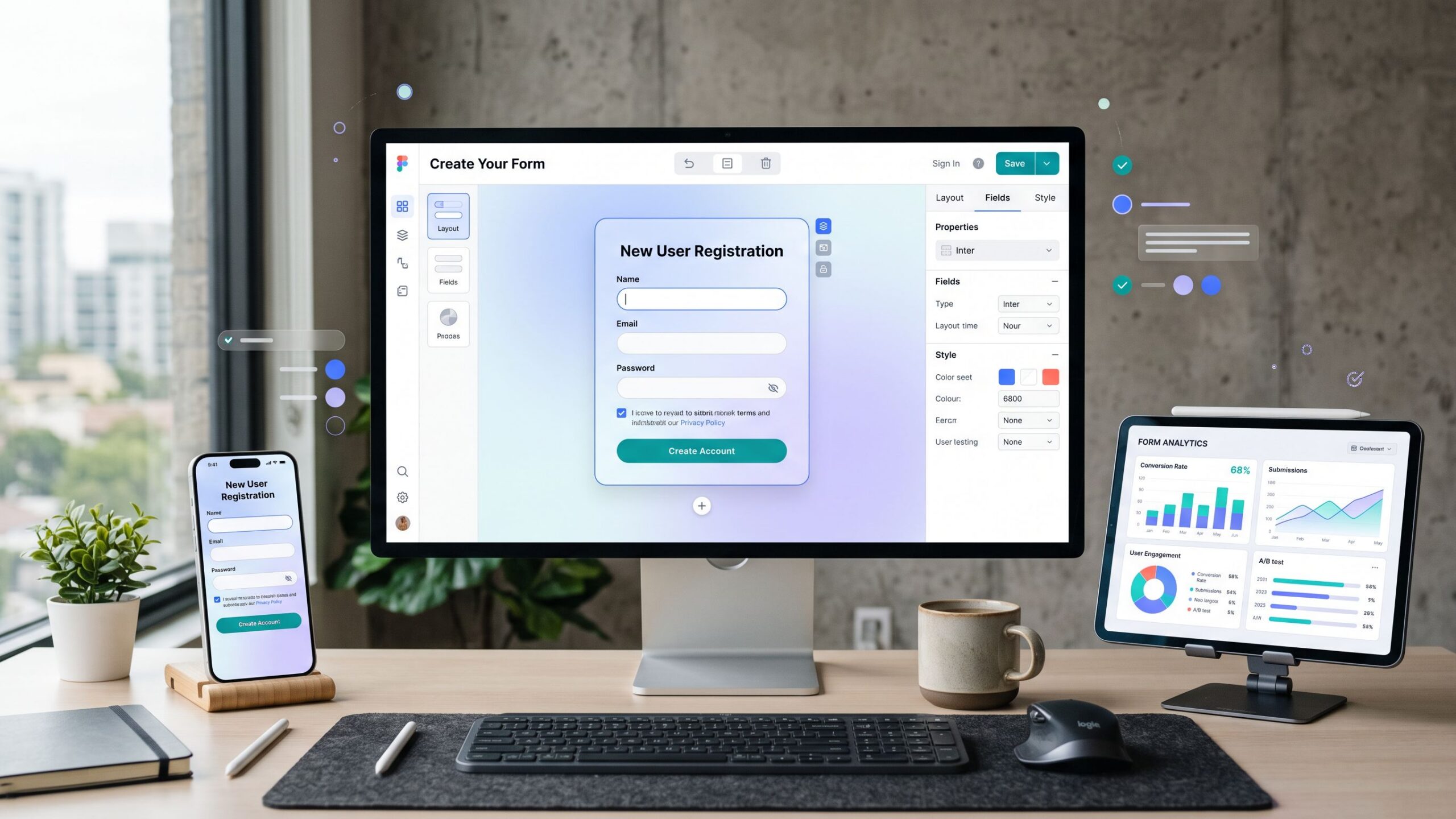
Businesses collect feedback every day, but collecting answers is only the beginning. The real challenge is turning those answers into useful decisions. Customer reviews, employee surveys, lead forms, product feedback, and market research can quickly create large amounts of data, and without the right system, valuable insights get buried inside spreadsheets and reports.
AI-powered survey tools solve that problem by doing more than simple form collection. They help businesses analyze responses faster, identify patterns automatically, detect sentiment, predict customer behavior, and uncover hidden trends that traditional survey tools often miss. Instead of manually sorting through responses, teams can focus on action and strategy.
Why AI Changes Survey Results
Traditional surveys are useful, but they often stop at basic reporting. You receive answers, review charts, and try to manually figure out what matters most. This takes time and often leads to missed opportunities because important patterns are hidden inside large datasets.
AI-powered survey tools improve this process by adding automation and intelligence. They can group similar feedback, detect emotional sentiment, identify urgent customer issues, highlight repeated complaints, and even predict churn risks based on response behavior.
This changes the value of surveys completely. Instead of using feedback only for reporting, businesses can use it for faster decisions and stronger forecasting. AI turns surveys from passive data collection into active business intelligence.
The goal is not just more responses. It is faster understanding and better action.
Start With the Problem You Need to Solve
Before choosing an AI survey tool, the first question should be simple. What decision are you trying to improve?
If the goal is customer satisfaction, you need sentiment analysis, NPS tracking, and automated feedback summaries that help identify service problems quickly.
If the goal is employee engagement, stronger reporting dashboards and trend analysis matter more because leadership needs clear visibility across teams and departments.
If the goal is lead generation, form intelligence and CRM integration become more important. AI should help qualify leads, prioritize responses, and automate follow-up actions.
If the goal is market research, predictive analytics and advanced segmentation matter most. Businesses need tools that help understand not only what customers said, but what those answers mean for future strategy.
Knowing the problem first makes platform selection much easier.
Best Overall: SurveyMonkey Genius
SurveyMonkey remains one of the strongest all-around platforms for AI-powered surveys because it combines strong reporting, business-friendly integrations, and AI-assisted survey building in one familiar system.
Its AI features help users create better questions, improve survey structure, and analyze responses faster without needing deep research experience. Automated summaries and smart recommendations reduce the time spent manually reviewing feedback.
SurveyMonkey works well for customer satisfaction, employee engagement, internal reporting, lead capture, and market research without becoming too complicated for everyday business teams.
Its strongest advantage is balance. It offers enough intelligence for serious business use while remaining simple enough for teams that want fast adoption without enterprise-level complexity.
For businesses that want reliable AI insights without a heavy learning curve, SurveyMonkey is often the safest starting point.
Best for Customer Experience: Qualtrics
Qualtrics is one of the strongest AI-powered survey platforms for businesses focused on customer experience and advanced decision-making.
It is built for organizations managing customer journeys, employee experience, product feedback, and brand perception at a much deeper level than standard survey tools. Its predictive analytics and advanced reporting help businesses move beyond basic feedback into long-term strategy.
Qualtrics uses AI for text analysis, sentiment detection, predictive insights, and customer behavior forecasting. This makes it especially valuable for enterprise teams where feedback directly shapes operations and leadership decisions.
It is not built for simplicity or low cost. It is built for businesses where data quality and decision accuracy matter at a very high level.
For enterprise research and serious customer intelligence, Qualtrics remains one of the strongest options available.
Best for Conversational Surveys: Typeform
Typeform stands out for businesses that want both AI insights and a better customer-facing experience.
Its conversational one-question-at-a-time design improves completion rates because forms feel more like interaction and less like paperwork. This is especially valuable for lead generation, onboarding, and customer feedback where presentation affects response quality.
Its AI features help improve question structure and response analysis while keeping the user experience smooth and engaging.
Typeform works especially well for agencies, consultants, coaches, and service businesses where customer trust and form completion matter more than pure survey volume.
The biggest downside is pricing, especially as response volume increases. However, when experience directly impacts conversion, Typeform often justifies the cost.
Best for Workflow Automation: Jotform AI
Jotform is often the best choice for businesses that need forms connected directly to operations, not just feedback collection.
Its AI-powered features support smarter intake forms, approvals, payment collection, onboarding, and workflow automation. Instead of forms ending with a response, they trigger action across the business.
Businesses handling registrations, contracts, service requests, and client onboarding often benefit more from Jotform than from traditional survey platforms because forms are tied directly to operations.
Its automation features reduce manual follow-up and improve speed across internal processes. For entrepreneurs managing appointments, service delivery, and approvals, this creates real day-to-day value.
The strength of Jotform is not only data collection. It is operational efficiency.
Best Free Option: Google Forms with AI Analysis Support
Google Forms remains one of the strongest free tools for basic surveys, especially when paired with AI analysis through Google Workspace tools or connected reporting systems.
Its biggest advantage is speed. It is fast to launch, easy to share, and connects directly to Google Sheets for live reporting and simple workflow management.
While Google Forms itself is lighter on built-in AI features compared to enterprise platforms, businesses can combine it with spreadsheet automation, connected dashboards, and external AI analysis for smarter reporting without major cost.
For startups, solo entrepreneurs, and small businesses with limited budgets, this creates a practical entry point into AI-supported survey workflows.
It may not replace enterprise tools, but it remains one of the most cost-effective starting options available.
Features That Matter Most
The best AI-powered survey tools are not chosen by the number of AI features listed on a pricing page. They should be chosen by how well those features improve real business decisions.
Sentiment analysis matters first. Businesses need to know how customers feel, not just what they selected in a rating box. AI that detects frustration, urgency, or satisfaction creates stronger decision-making.
Automated summaries save time by turning long text responses into clear action points instead of forcing teams to read hundreds of comments manually.
Predictive analytics matter for businesses focused on retention and growth. AI should help identify customers likely to leave, employees at risk of disengagement, or leads most likely to convert.
Integrations are equally important. Survey data should connect to CRM systems, email automation, reporting dashboards, and project management tools so insights lead directly to action.
Security also matters. Customer feedback, employee responses, and business operations often involve sensitive data, which means access control and secure storage must be part of the decision.
AI should simplify decisions, not create more complexity.
Common Mistakes Businesses Make
One of the biggest mistakes is choosing AI features before defining the business problem. More automation does not automatically mean better results if the survey itself is poorly designed.
Another mistake is collecting too much data without clear action. Businesses often ask too many questions and generate reports no one uses. AI works best when the survey has one clear purpose and one clear next step.
Ignoring the customer experience is another major issue. Even the smartest analysis tool cannot fix a form people refuse to complete. Completion rates still depend on good design, short surveys, and clear questions.
Many teams also forget that AI supports human decisions, not replaces them. Strong insights still require judgment, context, and leadership.
Technology improves strategy, but strategy must come first.
Final Verdict
The best AI-powered survey tools help businesses move faster from feedback to action. They reduce manual reporting, improve response quality, and turn customer answers into smarter decisions.
If you want the strongest all-around balance of usability and AI-assisted reporting, SurveyMonkey is often the best overall choice.
If enterprise customer intelligence and predictive analytics matter most, Qualtrics remains one of the strongest premium platforms available.
If completion rates and customer-facing design are the priority, Typeform delivers the best conversational survey experience.
If your forms need to trigger real business workflows, Jotform offers the strongest operational advantage.
The best AI survey tool is not the one with the most features. It is the one your team actually uses, your customers complete easily, and your business can rely on for better decisions every day.
Form and Survey Creation Software Reviews
Explore Nova Street’s Top 10 Best Form and Survey Creation Software Tools! Dive into our comprehensive analysis of the most powerful platforms designed to transform how you create, distribute, and analyze forms and surveys across every device. Our detailed side-by-side comparison chart helps you pinpoint the perfect solution for online surveys, feedback collection, registrations, quizzes, and data reporting—all in real time. We break down every critical element—question types, logic and branching, design customization, response limits, analytics and reporting, integrations, automation workflows, security and compliance, pricing, and cross-platform compatibility—so your data collection process stays smart, efficient, and seamlessly connected across Windows, macOS, iOS, Android, and the web.